

October 2025
Fight the Australian Labor
Party’s
Union-Busting Attacks on the CFMEU
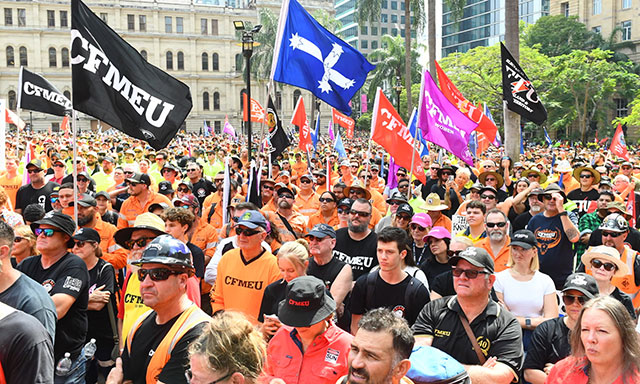
Thousands of members of the Construction, Forestry, and Maritime Union (CFMEU) took to the streets to protest government takeover of union division. Above: Brisbane, 27 August 2024. (Photo: Jono Searle / AAP)
SYDNEY, Australia – On June 18 the High Court of Australia (the country’s highest court) unanimously rejected a union challenge to legislation the Australian Labor Party (ALP) government imposed in August 2024 placing the construction division of the Construction, Forestry and Maritime Union (CFMEU) into administration to a government-appointed team. The legislation enabling this government takeover of what has come to be known as the most militant union in the Australian trade union movement was rushed through Parliament with the support of the conservative opposition Liberal/National Party coalition, which has long targeted the CFMEU for repressive legislation.
The charge against the CFMEU was “corruption” for which there were no indictments, no trials and no convictions. Nearly 300 union officials were immediately removed from their positions and government administrators will run all the construction division’s affairs, including its offices, finances and bargaining for a minimum of three years and up to five years. Any members of the union who “undermine” the administration face up to two year’s jail time.
The ALP attack on the CFMEU is the most severe assault on the Australian trade union movement since the 1998 lockout of maritime workers by the union-busting Patrick Corporation, with the full support and encouragement of the conservative government of then Prime Minister John Howard. Patrick attempted to replace locked-out workers with ex-military scabs while balaclava-clad security guards with attack dogs blocked workers from their jobs. Thousands of union supporters joined the maritime workers in mass pickets and this muscle forced a court decision reinstating the locked-out workers. While the bosses were unable to dislodge the Maritime Union of Australia (MUA), they secured many of their goals in subsequent bargaining, with the workforce virtually halving through voluntary redundancies (layoffs), casualisation and contracting-out of work. Working conditions were driven down while the pace of work intensified. A weakened MUA eventually sought refuge in a merger with the CFMEU in 2018.
Almost immediately after the an–nouncement of the takeover of their union, tens of thousands of construction workers took to the streets of major Australian cities including Melbourne, Sydney, Adelaide, Brisbane, Cairns, Canberra and Perth, in “stop work” actions that brought building projects to a standstill for the day. There were further “stop work” actions in Sydney, Melbourne and Brisbane. CFMEU members were joined in angry protest by members of the Building Industry Group (BIG) of blue-collar unions, including electricians, plumbers and manufacturing workers as well as activists from a wide range of other unions. And there were large numbers of these unionists at May Day 2025 rallies and marches across the country, notably larger than in recent years.
Workers’ anger was further inflamed when the Australian Council of Trade Unions (ACTU), the unions’ peak body, treacherously threw its weight behind the ALP assault on the CFMEU. This back-stabbing betrayal is further proof that the real loyalty of the upper levels of the union movement – the labour bureaucracy – and of the Labor Party is to capitalism and its state, not the interests of the workers they claim to represent.
The mass actions of CFMEU members together with their brothers and sisters in the BIG unions showed the willingness of many to use their own strength in fighting the government attack on their unions. But as the months wore by, with deposed CFMEU leaders counselling their members to await the High Court judgment, the workers’ anger was dissipated. Following the announcement of the High Court decision, there was no national response from the CFMEU. Members in Brisbane walked off the job in protest and former CFMEU national president Jade Ingham addressed them saying “We know the entire system is against us. But … they underestimate our resolve, they underestimate how prepared we are to take this fight on all the way until we win … mark my words we will win this fight.”1 In spite of having months to prepare should the High Court appeal predictively fail, no call to action or strategy was announced. In the main CFMEU strongholds, Melbourne and Sydney, there was silence.
The decision of the High Court exposes the lie that the capitalist state is “neutral” in the struggle between labour and capital. So, also, with the false assertion that the Labor Party actually represents workers’ interests. In the months prior to the federal elections in May 2025, there were reports that some union leaders were considering standing working class candidates in direct opposition to the ALP and even talk of forming a workers party. Over 80 union leaders from nine different unions in the BIG alliance met at a “Trade Unions for Democracy” summit in Canberra on 9 December 2024, ostensibly to put pressure on the High Court which was scheduled to hear the union’s appeal the following day. But union members waited in vain to hear any fighting strategy from their leaders.
The Demonisation of the CFMEU
This latest assault on the CFMEU was kicked off in July 2024 by a self-described “major investigation by The Australian Financial Review, The Age, The Sydney Morning Herald and 60 Minutes”2 into so-called corruption in the building industry. Most of the scandal-mongering charges in the “Building Bad” “exposé” centred on the Victoria branch as being “militant” and “out of control” and especially singled out 12-year Branch Secretary John Setka for being as “tough and feared a union leader as this country has ever seen”. Setka had previously announced his retirement for the end of this year but stepped down early, saying “These stories have been constant, and while I’ve been the target of many of them, enough is enough.”
The chief allegations against Setka and the union are old and tired, centring on claims such as the union hiring bikies (members of motorcycle clubs) for “standover” (shakedown) tactics to enforce concessions from recalcitrant building companies. In fact, and as is well known throughout the building sector, massive under-the-table payoffs by builders to local government officials for lucrative building contracts and permits are the real source of bribery and fraud in this industry. As an opinion piece by journalist Guy Rundle in “alternative media” outlet Crikey headlined: “Time to stand with the CFMEU against a cooked-up scandal.” He described infrastructure construction in the state of Victoria as “a predators ball,” adding: “The CFMEU made sure workers got their share, against the violence of capital”. Rundle continued: “The muscle appeared, from their side [major building companies], before the unions began to tool up to match it. ‘Security firms’ and then plain old bikies began appearing on sites on behalf of firms, precisely to keep union organisers off-site.” Rundle’s Crikey piece went on to say “the combination of the Fair Work Commission,3 anti-strike laws, and the active complicity of the right-wing unions has turned Labor and the industrial system into a smooth machine for the suppression of wages, wage demands, improved on-site conditions, and the possibility of industrial action.”4
Similar slander campaigns about “unions run by gangsters” were used against the CFMEU’s two main predecessors, the Building Workers’ Industrial Union (BWIU) and Builders Labourers Federation (BLF), unions that were “de-registered” (effectively banned from representing their members) by government action. In reality, they were targeted not for financial misconduct or consorting with criminals but to purge the influence of the Communist Party in their leadership and ranks.
Whether malfeasance exists in the CFMEU or any other union is a matter for its members to resolve. A class line of bitter hostility separates the interests of the working class and the injustices imposed by the ruling class. It is clear from the history of government intervention in the unions that such action is always to stifle militancy and opposition to capitalist exploitation, not to improve conditions for the workers.
Strangulation of the Unions
CFMEU leaders have baulked at calling full-on strike action or for solidarity strikes by other unions; such self-defence is illegal under Australian legislation governing unions, much of which was imposed by ALP governments. Compulsory arbitration has been a feature of Australian law since The Australian Conciliation and Arbitration Act 1904 established the Commonwealth Court of Conciliation and Arbitration, with support from the first Labor government of Prime Minister Chris Watson.
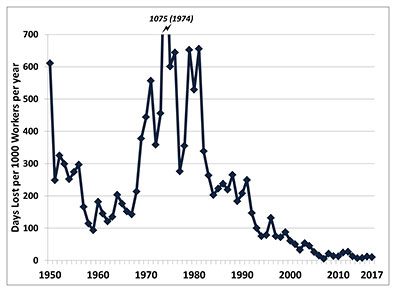 Number and duration of
strikes fell to near zero as a result of government
regulations under 1983 “Accord” imposed by ALP prime
minister Bob Hawke (below). (Bottom photo: Four Corners)
Number and duration of
strikes fell to near zero as a result of government
regulations under 1983 “Accord” imposed by ALP prime
minister Bob Hawke (below). (Bottom photo: Four Corners)
ACTU head Bob Hawke became the ALP prime minister in 1983 and over the next decade the ALP instituted an entangling matrix of government regulations and bodies known as the “Accord.” Collective bargaining is tightly constrained, industry-wide bargaining has largely been replaced by enterprise bargaining (weakening union strength), strikes can be called only in the most extraordinary circumstances and then can be ended by government fiat. By 1993, the number of strikes had declined by over two-thirds.
The “neoliberal” austerity policies implemented in Reagan’s American and Thatcher’s Britain were delivered in Australia by the Labor Party. Workforce unionisation declined from over 50% in the 1970s to just over 12% now, and a majority of those are in public sector jobs. Only about 8% of private sector employees are union members. These are the lowest rates of Australian unionisation in 120 years.
Sharply declining rates of unionisation were matched by the decline of strike action, which has declined by 97% from the 1970s to 2018.5 Moreover, as a paper by a “progressive” think tank notes, “There is a close statistical relationship between the near-disappearance of strike activity and the deceleration of wage growth, which has also slowed to the lowest rates in the postwar era…. Across the national economy, work stoppages have become extremely rare – and the extraordinary discretionary ability of industrial authorities to restrict or prevent industrial action is an important reason why.”6
The Labor Party’s 2009 “Fair Work Act” was touted as a complete replacement of most of the restrictions imposed on workers by the Conservative government of Prime Minister John Howard’s 2005 “WorkChoices” laws. In reality the ALP legislation continued the heavy-handed pattern of stringent curbs on union power. The Act bans industry-wide agreements (except in exceptional circumstances), bans pattern bargaining (whereby workers submit identical claims across multiple enterprises) and bans any group of workers taking action to support another (such as solidarity strikes). The Act also mandates the government to conduct union elections! It was this anti-union legislation that was amended (with support from the labour-hating Liberal/National coalition) to authorise the placing of the CFMEU into government control.
ALP Ulterior Motives
At the same time the anti-CFMEU media frenzy was running red hot last year, the fate of Prime Minister Anthony Albanese and his ALP government was looking shaky. Polls showed a steady decline for Albanese over two years, from the ALP election (after over a decade in opposition) in May 2022 and the media beat-up on the CFMEU in July 2024. The ALP was extraordinarily keen not to let any hint of scandal be associated with it, immediately suspending the union from any ALP activity and refusing to accept the union’s financial support, while it collaborated with the anti-union Liberal/National opposition coalition to rush through the Parliament the legislation establishing government administration of the union’s affairs.
In Australian politics, the Liberals have always been the most consistent union-bashers. The ALP wanted an issue that could counter any allegation of softness towards the unions and went into overdrive to be the most vociferous witch hunters.
As it turned out, the Labor Party won a crushing victory in the May 2025 federal elections: 94 seats for the ALP versus 43 for the Liberal/National Party coalition, the largest margin for a winning party in Australian history. To be sure, the Liberals’ party leader, Peter Dutton, ran such a terrible campaign that not only did his party haemorrhage seats but he lost his own and was dumped as party leader. Liberal/Nats proposals to scrap emission standards and build nuclear power plants never got any real traction. But what clearly tipped the entire election in the ALP’s favour was the “MAGA effect,” the revulsion against the “Make America Great Again” politics of Donald Trump. Just as the Liberal Party in Canada reversed its declining support when Trump declared he wanted to absorb the country as the 51st U.S. state, so the Liberals in Australia floundered over its MAGA-style rhetoric and ties to the U.S. President.
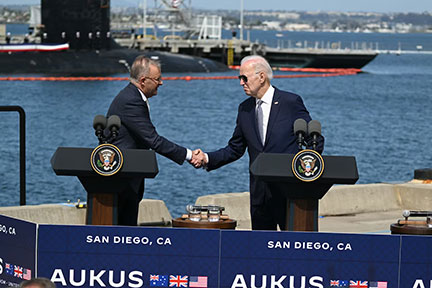 Australian prime minister
Anthony Albanese and U.S. president Joe Biden seal AUKUS
deal for nuclear submarines, San Diego, 13 March 2023. (Photo: Getty Images)
Australian prime minister
Anthony Albanese and U.S. president Joe Biden seal AUKUS
deal for nuclear submarines, San Diego, 13 March 2023. (Photo: Getty Images)But while the ALP basks in its victory, the seeds of its own decay are apparent and growing. A Lowy annual poll published in June 2025 found that barely half of the population have any faith in Australia’s economic performance for the next five years. Only 36% of Australians have any level of trust in the U.S., the lowest in 20 years of polling. More than 81% disapprove of Trump’s use of tariffs to pressure other countries to comply with his administration’s objectives and over two-thirds are pessimistic about the next four years under the Trump presidency. More than a third are opposed to the AUKUS deal to provide Australia with nuclear-powered submarines; that opposition has been growing with every poll. And in every category, faith in the future is the lowest among young people under 30.
Above all, what is driving the ALP government is the mobilisation for war on China, with Australian imperialism playing a key role in its U.S. big brother’s strategy of encirclement of the Chinese mainland. As in Europe, Australian workers’ living standards are being cut as the country gears up for war on China, by far Australia’s biggest trading partner. (Two-thirds of Australian export revenue comes from mining, most of it iron ore sales to China.) This issue is by no means abstract. Not long ago it was reported that U.S. under secretary of defence Elbridge Colby (whose grandfather was head of the CIA) was “pressing Japan and Australia to make clear what role they would play if the U.S. and China went to war over Taiwan” (Financial Times, 13 July). And now Japan’s new right-wing government of Sanae Takaichi (who styles herself a modern day Margaret Thatcher), is jacking up military spending and has threatened Japanese military action should Chinese move on Taiwan (The Independent. 12 November).
To defend itself, the Australian working class and its allies must oppose the anti-China drive. An internationalist program must combine combat against increasing immiseration and imperialist militarisation. Australian workers have been through nearly two decades of stagnant wages; increased casualisation of the workforce, without benefits or job security; the inability of most young people to ever own their own home. Even big business interests admit that that real wages of Australian workers have fallen by more than 10% over the last five years, and are now at 2009 levels.7 To change this reality requires replacing the capitalist system that the ALP is committed to preserving.
What Is to Be Done?
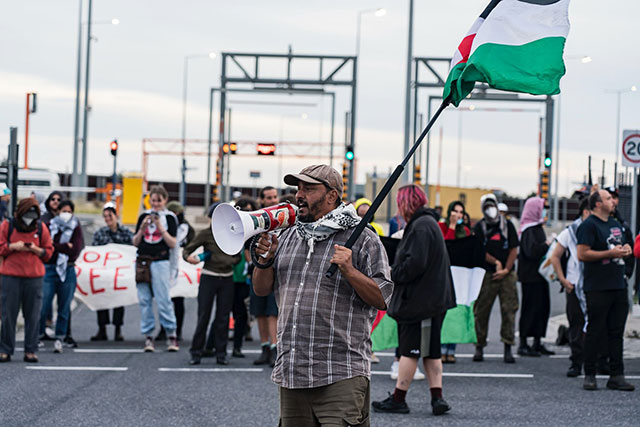
Mobilize labor’s power to stop war cargo to Israel. Above: protest blocks loading of Israeli ZIM Line ship at port of Melbourne, 18 January 2024. (Photo: Matt Hrkac / Middle East Eye )
The tens of thousands of workers who have rallied and marched in defence of their unions and their livelihoods show a willingness to fight and a readiness to take on the government. But most Australian workers have never been in a successful strike. The tangled web of legal and contractual constraints, implemented and enforced over decades with the cooperation of union leaders, blocks their way. As Leon Trotsky, co-leader of the Russian October Revolution of 1917 and founder of the Fourth International, wrote in Trade Unions in the Epoch of Imperialist Decay (1940), what’s needed is to:
“mobilize the masses not only against the bourgeoisie but also against the totalitarian regime within the trade unions themselves and against the leaders enforcing this regime. The primary slogan for this struggle is: complete and unconditional independence of the trade unions in relation to the capitalist state. This means a struggle to turn the trade unions into the organs of the broad exploited masses and not the organs of a labor aristocracy.
“The second slogan is: trade union democracy. This second slogan flows directly from the first and presupposes for its realization the complete freedom of the trade unions from the imperialist or colonial state…. The trade unions of our time can either serve as secondary instruments of imperialist capitalism for the subordination and disciplining of workers and for obstructing the revolution, or, on the contrary, the trade unions can become the instruments of the revolutionary movement of the proletariat.”
The stranglehold of the century-and-a-quarter-old system of rigid state control of labor in Australia – both under right-wing and ALP governments – will only be broken by sharp class struggle, led by a vanguard of the working class and the oppressed armed with a transitional program that leads the fight for today’s urgent needs forward to international socialist revolution.
The League for the Fourth Internationalist stands with the workers in the CFMEU, the BIG unions and all those who are under the hammer of the ALP government. We call for class struggle action to defeat the government which has hijacked the CFMEU.
No more secrets from the CFMEU membership! Elect strike committees to plan and implement the fight against government control of the union.
Build a campaign throughout the Australian labour movement to defy the injunctions and threats that will come, to hit the government with strike action in solidarity with the embattled CFMEU. An injury to one is an injury to all!
No support to the union-busting ALP. Build a revolutionary workers party to fight for a workers government!
- 1. The Queenslander, 19 June 2025, https://theqldr.com.au/queensland-news/2025/06/19/cfmeu-51/
- 2. Australian Financial Review, 25 July 2024, https://www.afr.com/companies/infrastructure/building-bad-inside-the-cfmeu-investigation-20240724-p5jwab
- 3. The Fair Work Commission (FWC) was set up under a 2009 reform as a labor relations tribunal for the settling of union-management disputes, retrenchments (layoffs) and other workplace issues.
- 4. Crikey, 19 July 2024 https://www.crikey.com.au/2024/07/19/cfmeu-scandal-guy-rundle
- 5. Jim Stafford, “Historical Data on the Decline in Australian Industrial Disputes,” Australia Institute, January 2018
- 6. Ibid.
- 7. See “Labor hides collapsing Australian living standards,” Macrobusiness, 24 July. https://www.macrobusiness.com.au/2023/07/labor-hides-collapsing-australian-living-standards/