

January 2026
For Workers Mobilization Against War on Russia and China
German Imperialism on the Warpath
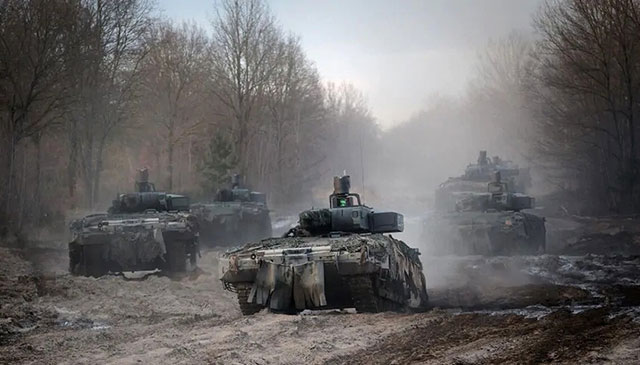
The German Puma infantry fighting vehicle on maneuvers in Lithuania, December 2023. The Bundeswehr German (armed forces) plans to send hundreds there, but will it have the soldiers? (Photo: Marco Dorow / Bundeswehr)
Working People and
Immigrants Targeted:
|
The following article is translated from Permanente Revolution No. 8, Winter 2025-26, the newspaper of the Internationalistische Gruppe, German section of the League for the Fourth International.
In his first government statement after taking office on May 14, the new German chancellor Friedrich Merz promised, or rather threatened, to make the Bundeswehr (the German army) “the strongest conventional army in Europe.” Even before the newly elected Bundestag (parliament) was convened, he had pushed through a constitutional amendment in the outgoing legislature to permit unlimited increases in military spending. This will reach €108 billion euros (US$127 billion) in 2026, an increase of 25% over the previous year. And preparations for the stationing of American medium-range missiles in Germany in 2026 are already in full swing. Flight time to Moscow: 6 minutes. Sold in the media as a “deterrent,” this is an enormous escalation of the nuclear threat against Russia.
In the same statement, Merz railed against an “escalating security situation” that would be met with increased police violence (“targeted strengthening and better equipping of security authorities”) and said that “enemies of our democracy” would be dealt with “with the utmost determination.” He would “declare war on the intolerable anti-Semitism that is reappearing in old and new forms on German streets and in German public life” – i.e., more repression against pro-Palestinian protests, continued military support for Israel, and, of course, not a word about the genocide committed by the Zionists (with bombs and bombers from the United States). In addition, increased European intervention in Ukraine, where “the peaceful order of our entire continent is at stake.”
The whole thing is a declaration of war on Russia, which was declared the main enemy in the coalition agreement for the Christian Democratic (CDU) and Social Democratic (SPD) government: “The greatest and most direct threat comes from Russia.” Wrong. The greatest danger comes from trigger-happy, warmongering leaders in Berlin, Paris, and London who are trying to stir up war hysteria. Every day we receive “news” that Russia is about to attack Germany. Drones (made of wood) in Poland, drones in Denmark, Russian overflights of “Estonian airspace” (in the Baltic Sea), Russian “disinformation” that must be comprehensively suppressed. The topic of discussion at NATO HQ in Brussels: should Russian fighter jets be shot down? Seriously. As if otherwise, Putin will march into Berlin the day after tomorrow. It’s insane.
The CDU/SPD government statement promises “prosperity for
all.” Even more madness. At the end of 2025, the national
deficit is soaring due to military spending; the metal and
chemical industries are in crisis, with layoffs continuing
in these sectors, and pensions and unemployment benefits are
under attack. Unemployment reached its highest level in 15
years in August, at over 3 million. Volkswagen is closing a
plant in Germany for the first time in 88 years. Real g
Gross Domestic Product (price- and seasonally adjusted):
2023: -0.27%; 2024: -0.5%; 2025: 0.0%. The conclusion:
stagnation. The main reason is high energy prices, a
consequence of the loss of cheap Russian natural gas due to
sanctions, which led to mass layoffs and plant closures.
Merz repeatedly refers to a (mythical) Russian invasion of Germany or NATO territory. “We would respond to Russian attacks,” he said recently (Die Welt, 17 December 2025).1 With its incessant propaganda barrage, the government has succeeded in convincing 49% of the German population that Russia poses a threat, according to a YouGov survey for the Deutsche Presse-Agentur (20 July 2025). On the other hand, 44% of those surveyed believed that Moscow posed little or no threat. Despite all the talk about Germany’s “war readiness”, it is clear that there is still no enthusiasm for war and no willingness to make sacrifices.
However, this rubbish can have serious consequences. When it was reported in mid-September that Russian fighter jets were flying near Estonia’s Vaindloo Island,2 the Italian NATO commander scrambled F-35 fighter jets that were on quick reaction alert to intercept the Russian Mig-31 jets. The NATO spokeswoman accused Russia of recklessness. On the contrary, the Western military alliance’s response was reckless gambling with nuclear war. And since the European NATO countries themselves will not be able to wage a direct war against Russia, even with their planned rearmament, this points to the main target of this militarization: their own populations. The tanks will be used in Germany and the EU.
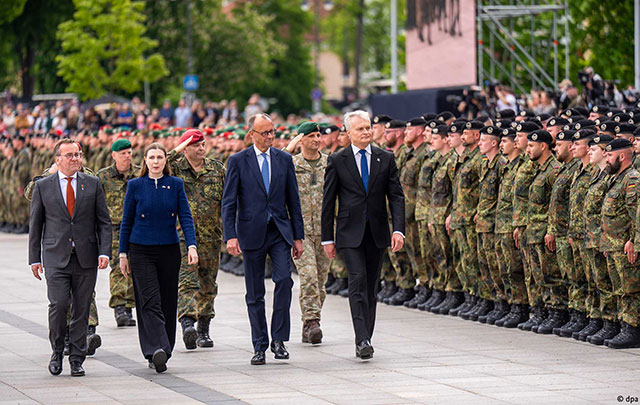
German war minister Boris Pistorius (left) and federal chancelor Friedrich Merz inspect a Bundeswehr combat brigade with Lithuanian president Gitanas Nausėda (right) and the prime minister Inga Ruginienė in Vilnius on 22 May 2025. This marks the first long-term deployment of a large contingent of German troops abroad since World War II. (Photo: dpa)
The purpose of the current military build-up and political mobilization for war is to eradicate the last vestiges of the “welfare state” established after World War II in the imperialist countries of the European Union and NATO, which are in a prolonged economic and geopolitical crisis. It is to achieve “combat readiness” for capitalist class war against the working people in order to ward off the danger of revolution. That is why it is all the more important to counter the frantic war preparations and slashing of social programs with revolutionary class struggle. Above all, it is essential to take up the indispensable task of building a genuine communist workers party as the vanguard of all the exploited and oppressed.
The Europe-U.S. Divide: Intensification of Inter-Imperialist Competition
The Bonapartist police state regime being built up by the would-be dictator, U.S. president Donald Trump, released its National Security Strategy on December 5 under the watchword “America First.” With regard to Europe, its stated goals are to restore “strategic stability with Russia,” “reduce the risk of conflict between Russia and European states” and “promote resistance to Europe’s current course.” And, of course, to “open European markets to U.S. goods and services.” So, it is aiming for a trade war and implicitly calling for “regime change” to promote “patriotic parties,” in this case, above all, the fascistic Alternative for Germany (AfD).
European leaders claim that Trump has allied himself with Putin against Ukraine. But the U.S. defense budget provides for further funding for Kiev, albeit at a reduced level of $400 million over the next two years, as part of the Ukraine Security Assistance Initiative, which pays U.S. companies to supply weapons to the Ukrainian military. It also approved the Baltic Security Initiative and allocated $175 million to support the “defense” of Latvia, Lithuania, and Estonia. And the number of U.S. troops in Europe is not to fall below 76,000 (current level: 80,000). However, the European imperialists will have to self-finance the purchase of military equipment that would prolong or expand the war, such as the Taurus missile system.
Furthermore, the second Trump administration is continuing the Biden administration’s plan to station Tomahawk medium-range missiles and Dark Eagle hypersonic missiles, both with nuclear capability, in Germany starting in 2026. This means that if Russian defense systems detect their flight, Moscow must assume that Russia is under nuclear attack and respond accordingly. This provocation has already been given the green light by the German government as an “executive decision.” To stop this, workers action is urgently required. There should be mass resistance as in October 1983 when well over a million people took to the streets to prevent the deployment of U.S. medium-range missiles. A general strike against this was proposed.
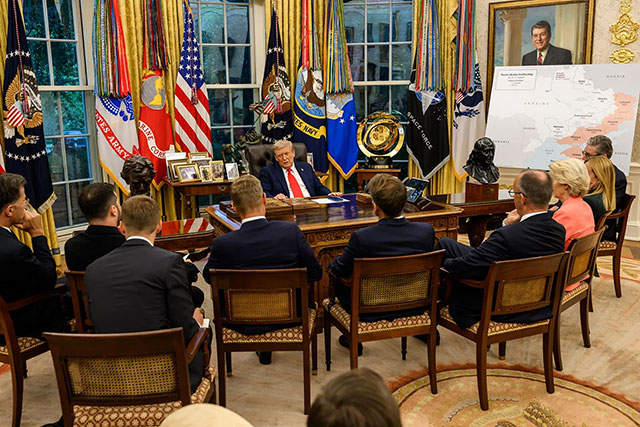 “Donald Trump and the
Seven Dwarfs.” On 19 August 2025, the U.S. president
summoned Ukraine’s puppet president Zelensky (left) and
European heads of state and government, including German
chancellor Merz, European Commission president Ursula von
der Leyen. (Photo:
Daniel Torok / White House)
“Donald Trump and the
Seven Dwarfs.” On 19 August 2025, the U.S. president
summoned Ukraine’s puppet president Zelensky (left) and
European heads of state and government, including German
chancellor Merz, European Commission president Ursula von
der Leyen. (Photo:
Daniel Torok / White House)The European NATO countries continue to cling to the illusion of an impossible Ukrainian reconquest of Donbass and Crimea, even as U.S. support in a land war with Russia is in serious doubt. And while the European imperialists talk of an “interposition force” or “peacekeeping force” to give Ukraine “firm security guarantees,” Russia will never tolerate this. This is another reason why plans for a massive rearmament of Europe are coming to the fore, with Germany assuming a leading role. But the impossibility of the Europeans waging war against Russia on their own (without the U.S.) explains the repeated capitulations of the German bourgeoisie and the EU to the U.S. on tariffs and other economic issues.
The only surprise from Germany’s “black-red” (Christian Democrat/Social Democrat) coalition government was the anti-American stance of Friedrich Merz, the man representing US financial capital in Germany (he was head of BlackRock Germany, the branch of the New York investment giant). On 24 February 2025, he told Handelsblatt: “For me, the absolute priority will be to strengthen Europe as quickly as possible in order to step-by-step achieve genuine independence from the U.S.” The European Union (EU), originally founded as the economic backbone of the U.S.-dominated NATO, is now taking on its own military role, with increasing calls for a “European army.” This makes it clear that the slogan “Germany out of NATO,” raised by a range of left-wing groups, is nationalist and by no means anti-imperialist.3
A disturbing symptom: a few months after the start of the war over Ukraine, one of the editors of the Frankfurter Allgemeine Zeitung (29 October 2022) asked: “Does Germany also need the bomb?” But German imperialism would also need missiles and fighter jets to drop the (nuclear) bombs. Recently, CDU parliamentary group leader Jens Spahn stated, “We need to talk about German or European participation in the nuclear arsenal of France or Great Britain, possibly also about our own participation with other European states” (Tagesspiegel, 28 June 2025). Merz responded: “No, the time is not ripe for that” (Frankfurter Allgemeine Zeitung, 16 October). Not today, but tomorrow or the day after tomorrow?4
Making War Happen with Ever More Weapons
A key element of the war drive is the Bundestag’s decision of 18 March 2025 to exempt all defense spending above one percent of Gross Domestic Product (GDP) from the “debt brake” (the constitutional amendment that a previous CDU/SPD coalition had pushed through in 2009 to limit the “structural” budget deficit to 0.35 percent of GDP). This means that military spending can now be increased without limit. Due to the poor showing of the SPD and the Greens (leaders of the previous governing coalition) in the February 2025 federal elections, the right-wing Alternative for Germany and the Left Party now have a “blocking minority” of more than one-third of the seats in the Bundestag. This allows them to block constitutional amendments and present themselves as opponents of the government. That is why Merz (and SPD Minister of War Boris Pistorius) had to get the outgoing Bundestag to pass the constitutional amendment [making an exception to the “debt brake” for military expenditures].
On 21 March 2025, these financial measures were then also approved by the Bundesrat (the upper house of Germany’s parliament). Since the Left Party (Die Linke) did not raise any objections, the states of Bremen and Mecklenburg-Vorpommern (where Die Linke has ministers) agreed. The Bremen Left Party reaffirmed its support for the war credits, citing “the political responsibility of our Left [sic] participation in the state government.” At a Die Linke party conference in Chemnitz in May 2025, the leadership promised to pressure state branches to implement the party’s national policy of the Left Party. But nothing happened.
Then, on June 26, the Bundestag passed tax breaks for companies. The Greens and the Left Party voted against it. But on July 11, this measure was unanimously passed in the Bundesrat. Again there was no opposition from the Left Party in Bremen and Mecklenburg-Vorpommern (nor from the Greens or the BSW5 in the federal states where they are part of the government). After making a big fuss in the Bundestag, they then simply waved it through in the Bundesrat. And above all, when it really mattered in the Bundestag, on May 6, the Left Party rushed to Merz’s aid by agreeing to a change in procedural rules, thus enabling him to be elected chancellor in a second vote on the same day. “Federal-level political responsibility,” it seems.
Meanwhile, on 19 March 2025, the European Union under Ursula von der Leyen (the former German defense minister) presented its “ReArm Europe/Readiness 2030” plan. Military spending is now exempt from the EU’s Stability and Growth Pact, which since 1997 has limited national budget deficits to 3 percent of GDP and total government debt to 60 percent of GDP (around €800 billion in Germany). The program includes a €150 billion loan program called “Security Action for Europe” (SAFE). The von der Leyen clique used emergency powers, which only require a majority in the European Council, thereby bypassing the European Parliament and vetoes by individual European countries.
One need only recall the rigidity with which former German chancellor Angela Merkel’s government in Berlin, together with Frankfurt bankers and Brussels eurocrats, pushed Greece’s working class into poverty in order to stubbornly adhere to these financial rules. And now, in order to spend billions of euros on tanks and fighter jets, they are suddenly gone. The financial greed of the European imperialists is also reflected in their fixation on seizing Russian assets in order to arm the Ukrainian military. On December 19, this plan was definitively vetoed by Belgium, and now EU governments must take out loans for €90 billion, which taxpayers will later have to repay (with interest).
The EU is not a “superstate” but rather a loose imperialist coalition founded on a German-French axis. Coordinated European armament plans will prove difficult. Cooperation between Berlin and Paris is far from smooth, and cooperation with London remains limited since Brexit (the 2016 British exit from the EU). Most arms companies are relatively small, lacking economies of scale and research coordination. They lag behind their U.S. and other competitors in satellite and missile technology. In addition, they frequently compete with each other. Given the resources required, the billions of euros appear rather insufficient.
The masters of German capitalism have repeatedly shot themselves in the foot. First, they gave up cheap energy in order to “punish” the Russians. Now they are supposed to “decouple” from China, following losses and setbacks in export competition for cars and other industrial products. They must therefore continue to ally themselves with U.S. imperialism, which is stabbing them in the back, while they chase the illusion of recouping their losses through “reparations” from a defeated Russia. All they can get out of these efforts is to create a new arms giant. Based on current sales figures, Rheinmetall would rank second among arms companies worldwide, behind the U.S. giant Lockheed Martin, the manufacturer of the F-35 fighter jet.
Rheinmetall is now “Europe’s hottest stock” (recalling Rosa Luxemburg’s 1914 statement: “dividends rising, proletarians falling”). The company increased its annual production of 155 mm artillery shells from 70,000 in 2022 to 750,000 in 2024, and aims to reach 1.5 million by 2027. But its tanks and frigates could be easy prey if the company does not catch up in drone and satellite technology. For drones, Rheinmetall is collaborating with the notorious U.S. defense technology company Anduril – but the first field trials were not promising. Does the bourgeoisie really think that military spending will revive the economy? In any case, their tanks can only intimidate the smaller countries of Central Europe, certinly not Russia.
The Eastern Front Is Everywhere
The Merz administration intends to escalate on the Eastern Front. It has announced that it will no longer disclose information about arms deliveries to Ukraine. If Merz carries out his plan to deliver Taurus missiles to Ukraine for use against Russia, the German population will be kept in the dark about this dangerous step toward world war.
On May 22, Merz traveled with Defense Minister Pistorius to Vilnius, Lithuania, to officially open the first long-term deployment of a large Bundeswehr unit abroad since World War II — the 45th Tank Brigade with 4,800 soldiers. A few months later, a Bundeswehr propaganda film showed an eerie torchlight ceremony, accompanied by martial music from the Lord of the Rings movie, during a visit by the new army chief, Lieutenant General Christian Freuding. They are training there for rapid deployment against the presumed enemy, Russia. Back in February 2025, CDU politician Johann Wadephul, now foreign minister, declared: “Russia will always be an enemy to us.”6
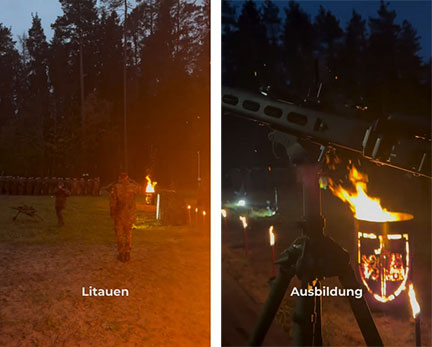 Ominous torchlight
ceremony on the grounds of the Bundeswehr brigade in
Lithuania during a visit by army inspector Christian
Freuding, October 2025. (Photo:
Bundeswehr)
Ominous torchlight
ceremony on the grounds of the Bundeswehr brigade in
Lithuania during a visit by army inspector Christian
Freuding, October 2025. (Photo:
Bundeswehr)Nowhere is this better illustrated than in the Baltic states, the former territory of the medieval Teutonic Knights and of the reactionary Freikorps7 after World War I. Furthermore, the Baltic governments are among the most vocal Russia-haters in Europe, like EU foreign policy chief Estonian Kaja Kallas, whose grandfather was one of the founders of the Estonian Defense League, which fought against the Bolshevik Red Army in 1918-1919. Kallas has vehemently called for the confiscation (theft) of Russian assets in European banks, spoken out against any territorial concessions in Ukraine, demanded that the war can only end with a Russian defeat, and called for Russia to be broken up into smaller countries.
As part of the German-led NATO “Lithuania Battle Group,” together with troops from the Netherlands8 – which are already integrated into the German Armed Forces – Berlin would place Belgian, French, Croatian, Luxemburg and Norwegian contingents under German command. “The protection of Vilnius is the protection of Berlin,” Merz claimed in his speech in Vilnius. As for the accelerated expansion of the German military, he says, “our allies rightly expect this of us; more than that, they are demanding it.” With his delusions of grandeur, Merz wants Germany to become the guardian of Eastern Europe. On the way to a “Pax Germanica”?
Preparations for war are not only evident on NATO’s eastern border. Germany’s role as a “hub” is now the buzzword in the government’s war propaganda. This means that the German armed forces are to channel the transport of troops and weapons to the east.
“Berlin estimates that 20% of autobahns and over a quarter of autobahn bridges are in need of repair due to chronic underinvestment. According to the Central Association of German Seaport Operators, Germany’s North Sea and Baltic Sea ports require investments of €15 billion, including €3 billion for the modernization of dual-use infrastructure, such as the reinforcement of dock facilities.... Longer term, Berlin aims to spend €166 billion by 2029 on infrastructure, including more than €100 billion on the long-neglected railways, and give priority to dual-use infrastructure.”
– “Germany’s Secret Plan for War with Russia,” Wall Street Journal, 27 November 2025
In addition to the special fund for armaments, there is also a “special infrastructure fund” amounting to a further €500 billion, which is far from sufficient for a comprehensive modernization of the entire national infrastructure. This means that there will be almost no investment in civil infrastructure in the foreseeable future.
However, the build-up is not just about armament and deterrence – the top brass at Germany’s Ministry of Defense are preparing for action. German military trainers complain that there are “too many soldiers who have never experienced war.”9 There is zero chance that Russia would attack Germany, as it has neither the power nor the interest to do so. If, on the other hand, fighting were to break out along the 100 km long “Suwalki Gap” along the Polish-Lithuanian border separating Belarus from the Russian enclave of Kaliningrad,10 it would be over quickly, as Russia would have the upper hand. However, there could be Western provocation, as the commander of U.S. forces in Europe hinted in July when he threatened that NATO could “take down” Kaliningrad with “unprecedented” speed.11
But when the Chief Medical Officer of the German Armed Forces talks about preparing for 1,000 casualties per day,12 it is clear that this refers to deploying German troops to Ukraine. Even if they are described as “peacekeeping forces,” neither the German army nor NATO troops would be accepted by Russia, and their deployment would be a war provocation. This is so obvious that such plans could be classified as utter nonsense. However, one should never underestimate the senselessness of warmongering imperialists. An example of this was the wiretapped telephone conversation between high-ranking German generals in February 2024 about the delivery of Taurus missiles to Ukraine, at a time when then-chancellor Olaf Scholz declared that these missiles would not be sent.
The German army that carried out Hitler’s carnage, the Wehrmacht, was disbanded after World War II. However, when the Bundeswehr was founded in 1955 at the height of the anti-Soviet Cold War, its first leaders were former Wehrmacht staff officers. Its first commander, Lieutenant Colonel Karl-Theodor Molinari, was accused of participating in the murder of 105 French resistance fighters in Tulle in 1944. Despite all the talk of “inner leadership” and commitment to a “democratic order,” there have always been fascist networks in the Bundeswehr that have supplied Nazi terrorists. In 2024, there were nearly 100 dismissals of soldiers for right-wing extremism (and 875 cases), but that is only the tip of the iceberg.
For the German imperialist army and the sinister forces stirring within it, Russia has been the enemy since 1900, through two world wars and decades of Cold War. Now the Bundeswehr is being armed for war on the Eastern Front, but it also coordinates with the internal repressive apparatus, especially when a state of emergency is declared.13 While conscripts are “workers in uniform,” the army (together with the police, judiciary, domestic intelligence agency, etc.) is the armored fist of capital. The struggle against militarization is therefore a defense of democratic rights and must be based on the mobilization of the working class to defend all those who are exploited and oppressed by capital. ■
- 1. The Bundesnachrichtendienst (BND, Federal Intelligence Service, Germany’s international intelligence agency, equivalent of the CIA) has been granted “operational authority” to carry out “preventive” acts of sabotage in an undeclared war against Russia “if appropriate police or military assistance cannot be obtained in time or if the measure is to be carried out on the territory of a foreign state,” i.e., the BND can carry out such attacks inside Germany as well. (“Espionage, Sabotage – Controversial Draft of the BND Law,” Tagesschau, 18 December 2025). And NATO is already waging cyberwar against Russia from Estonia (Die Welt, 19 December).
- 2. The island (one of over 2,000 that Estonia has in the Baltic Sea) is a speck in the middle of the Gulf of Finland, on a direct flight route from Saint Petersburg, and has an area of 1/40th of a square mile, or 1/10th the size of Roosevelt Island, the tiny sliver in New York City’s East River.
- 3. German Far Left in Crisis: Nationalist ‘Peace Movement’ or Internationalist Class War?” The Internationalist
- 4. A paper by the Federal Academy for Security Policy, “Not Yet War, But Not Peace Either” (2025), argues: “The often-repeated mantra that nothing can be done to counter a nuclear power would be precisely the wrong and fatal conclusion, because nuclear weapons are not omnipotent.”
- 5. Bündnis Sahra Wagenknecht, the populist party of the former leader of the Communist Platform in the Left Party.
- 6. On October 19, Merz announced to Russia: “We will have to defend ourselves again [our emphasis].” Again, like in 1914? Or 1941?
- 7. The paramilitary militias raised by the Social Democratic government to fight the Communists after the fall of the monarchy in November 1918 – including assassinating Rosa Luxemburg and Karl Liebknecht in January 1919 – many of whose members went on to aid the rise of the Nazis to power.
- 8. The I German-Dutch Corps has been in existence since 1995. It now comprises 10 additional national contingents and was deployed in Afghanistan in 2003, 2009, and 2013.
- 9. See “Germany’s Army Is Rebuilding. What Could Go Wrong?” Politico Magazine, (September 2025.)
- 10. See the lead scenario in the “war edition” of Politico Magazine (September 2025).
- 11. See “Dying Imperialism Lashing Out on the Road to World War III,” The Internationalist No. 76, June–October 2025.
- 12. See reference in the article on “School Strike: No ‘Cannon Fodder’ for German Imperialism!” The Internationalist No. 77, January–March 2026.
- 13. See “Life in an Armored Republic” The Internationalist No. 77, January–March 2026.